Edition 8
Nov 13, 2025

Your Business Snapshot:
🏦The UK prepares for upcoming fiscal and monetary decisions, as figures disappoint.
📱Duolingo - How does the companies striking business model turnover a profit?
📉 Tech led a slump as layoffs and data stoked valuation fears, pulling US and European indices lower.
💻 Apple widens chip edge. Performance lifts services and hardware profitability.
Economics
UK economic figures set a precedent for monetary and fiscal decisions
UK unemployment has just hit a high of 5%, even as inflation is falling and interest rates may soon be cut.
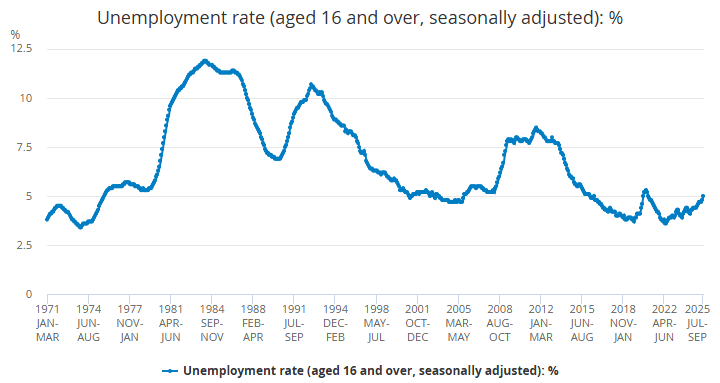
Unemployment in the UK has risen to a staggering 5% over the last few months, the highest level in about a decade outside the global pandemic[]. This comes after traders speculate that the Bank of England will cut interest rates to fill the fiscal hole and boost the stagnating economy. High unemployment rates reflect how payroll employment has fallen by 180,000, coinciding with Chancellor Rachel Reeves’ Budget last year. It is expected by traders and economists alike that the upcoming budget on November 26th will further raise taxes and reduce the current fiscal hole that economists estimate to be £30bn[1]. Many businesses and small corporations fear that this will raise employment costs which are already very high, and therefore must protect themselves by laying off workers or reducing worker capacity.
This has several impacts for the UK economy, as unemployment rises, people will be out of jobs and hence incomes. Their purchasing power therefore decreases, meaning they have less to spend on everyday goods like shopping groceries or holiday trips. As a result, people tend to save more and reduce overall consumption and demand which whilst it may reduce pressure on prices and inflation, it holds a detrimental effect to a country’s productive potential, creating slack and idle capacity which could further reduce its GDP and economic growth.
These sobering figures are a reflection on the UK's weakening labour market and economy as a whole. An ONS survey shows that wage growth has since stagnated at the 4.6% mark, with Governor Andrew Bailey further suggesting that wage growth might ‘plateau’. So what does slower wage growth mean for the UK economy? This has several knock-one-effects as it could create weaker inflationary pressure as businesses find it harder to raise prices. This could mean that inflation is likely to fall back, even without very high interest rates. For the Bank of England, weaker jobs and softer pay could reduce the risk of inflation being too volatile, and increase the risk of a deeper slowdown. As a result, a deteriorating labour market often creates pressure for interest rates to be cut as it could further stimulate spending and increase overall demand within the UK[2].
Business
Duolingo: Free and Profitable?
Have you kept a Duolingo streak for months and never paid a penny? So how does a “free” owl turn that into real money at scale?
Duolingo’s model is simple on the surface and sophisticated underneath. The app runs a freemium funnel:
Most learners use the product free with ads
A minority upgrade to Super/Max subscriptions for an ad-free, faster path and AI features
Some buy in-app items (Gems, Streak Freeze)
And another revenue stream comes from the Duolingo English Test, an online proficiency exam accepted by thousands of institutions worldwide.
In Q1-2025 Duolingo reported 46.6 million daily active users, 10.3 million paid subscribers and $230.7 million in revenue, with positive net income and 27.2% adjusted EBITDA margin[4]. Management then guided 2025 revenue to ~$963 - $979 million, citing strong adoption of AI-enhanced subscription tiers[3].

What converts free usage into cash is not just scale, but data. Every tap, mistake, hint, and notification response generates feedback used to personalise lessons, set difficulty, and nudge habit formation. That loop improves learning outcomes and raises monetisation: better retention leads to higher ad impressions per learner, and a greater share of users who decide the premium tier is “worth it.” Duolingo publicly credits extensive A/B testing and machine-learning decisioning for measurable gains in ad yield and conversion[1][5]. In other words, the lessons are the product you see; the behavioural data is the asset.
The English Test adds a distinct business logic. Unlike the consumer app, the DET is a paid, transactional product with institutional demand. In 2024, DET revenue reached about $45.6 million, with volumes roughly stable year on year, giving Duolingo a counter-cyclical pillar less tied to in-app ad markets[2]. Together with premium subscriptions (the majority of revenue) and a growing virtual-goods line, the mix reduces single-point risk while keeping the free top of the funnel wide.
There are, however, limits. Advertising can pressure gross margins, and rapid rollout of AI features has near-term cost implications (compute, moderation) even as it drives bookings[3][6]. The core moat (data at consumer scale) must be managed within privacy frameworks and platform policies. And while engagement gadgets (streaks, leagues) boost daily use, they must keep delivering real progress to sustain pricing power and brand trust.
Still, the strategy is clear. Duolingo uses a mass-market, game-like front end to generate a proprietary data flywheel that improves learning and monetisation. Subscriptions, ads, the English Test and virtual goods then turn that engagement into revenue. You may never pay for your streak, but the system around it is designed so someone happily does.
Markets
Markets Drop as Job Cuts Rise and Tech Confidence Slips
The U.S. stock market, including the S&P 500 and the Nasdaq Composite, dropped sharply on 6 November 2025. The Nasdaq fell about 1.9%, and the S&P 500 lost 1.1%. Tech stocks were the most brutal hit, as worries grew about layoffs, high valuations, and uncertain economic data.

The Guardian presents a private report from Challenger, Gray & Christmas showing 153,000 job cuts in October, the worst October since 2003. Many companies, especially in tech and warehousing, are freezing hiring or cutting staff. This has made investors question whether the recent optimism around AI and big tech is justified. Because of the U.S. government shutdown, many official reports on jobs and inflation have been delayed. Investors are relying more on private data, which adds to the uncertainty. The Guardian also highlights that Chris Beauchamp from IG.com said: "The lack of US data and the ongoing government shutdown is making investors nervous[2]." The job market is a key signal of economic health. With layoffs rising, markets fear a slowdown. Furthermore, according to The Financial Times, October's job cuts tripled from a year earlier, totalling 153,000, compared with 55,597 in October 2024[3].
The Wall Street Journal focuses on tech and says that much of this year's rally came from AI-related tech stocks, but those same companies are now dragging markets down. Investors fear the AI boom may be slowing or that profits will take longer to appear. Because tech firms make up such a large share of the indexes, their decline pulled the entire market lower. Tech valuations are also looking stretched. The Nasdaq's forward earnings ratio is around 29 (higher P/E ratio implies overvalued price compared to earnings), compared with an average of 25 over the past decade. This has raised fears of a bubble, in which stock prices rise far above their fundamental value. As Neil Birrell, chief investment officer at Premier Miton, put it: "It goes to show how fragile the market is, how everyone is in the same trade"[1].
Finally, The Economist Times reports that the selloff spread to Europe, with the FTSE 100 down 0.4%, the Stoxx Europe 600 down 0.7%, and Germany's DAX down 1.3%. The Federal Reserve (Fed), which is America's central bank, faces a tough challenge. With little official data available, it must decide on interest rates with limited information. Fed board member Austan Goolsbee said the missing inflation data has made him more cautious about cutting rates further[4].
Tech
Apple’s M4 speed boost
Apple’s new M4 chip is the fastest processor Apple has ever put inside a Mac or iPad. It adds more memory, a quicker way to move data and a special low‑power part that handles tasks in the background without draining down the battery. Tests show the M4 is about 30 percent faster for single tasks and roughly 20 percent quicker compared to previous silicon M3. For businesses that edit video, run big spreadsheets or use any demanding software, the quicker speed means work gets done faster and employees can complete more tasks in a day than usual[1].

The chip also makes daily smart features run smoother. Things like photo search, voice commands and real‑time translation happen faster because the M4 has a bigger engine for these jobs. Because the work can stay on the device, companies don’t need to send data to external servers, which helps keep information private. The new power management lets laptops stay on a single charge for up to 20 hours even when they are being used heavily, a clear benefit for people who travel a lot[2].
From a business point of view the M4 could help Apple earn more from its services. Faster hardware encourages app creators to build richer experiences, and the improved chip opens the door for new subscription‑based tools that run directly on the device. Analysts have already nudged their price forecasts for Apple higher, saying the M4 should lift profit margins on hardware and drive growth in services. Early customers say they are spending less on extra graphics cards and cloud computing because the M4 handles those jobs on its own[1].
The launch also changes the wider computer chip market. Companies that have relied on buying chips from other makers may feel pressure to start designing their own. Suppliers that provide memory and packaging for Apple are likely to see more orders. For investors, the M4 reinforces Apple’s reputation as a leader in building its own chips and suggests the company will keep growing both its hardware and its service offerings[3].
In short, Apple’s M4 chip offers noticeable speed gains, smoother everyday smart features and longer battery life. These benefits give businesses tools that are quicker, easier to run and easier to keep secure. The chip also fits Apple’s bigger plan of expanding its services and keeping its ecosystem strong, which should keep the company’s outlook positive for the future[2].
Bonus Section
Insider resource pyramid
5 Opportunities (within University)
Impact Projects - provides real world experience working with SMEs and NGOs (second cohort starting in second semester)
180DC consulting project
BFS analyst
SOBIC analyst
BBS newsletter writer
4 News Channels / Market Insights
Financial Times - free subscription through the University
Bloomberg Terminals - available in the School of Management
Barebone AI - application that provides market insights using AI
The Economist - espresso section free for students
3 Books
Vulture Capitalism by Grace Blakely
Makers and Takers by Rana Foroohar
The Smart Method by by Stephen Clapham
2 Courses
Investment Foundations Certificate by CFA
FMVA by CFI
1 Habit
Read about and track stocks and economies
Editors: Liam Sanderson, Dinel Gamage
Writers: Liam Sanderson, Filip Wang, Cleo Vuillot, Harshil Nichani
References:
Economics:
[1] Financial Times - https://www.ft.com/content/cabfdcd8-393e-4bba-b802-38fc8f8b09c1
[2].Financial Times - https://www.ft.com/content/8505e8b0-219a-4530-aebf-74e59ffc0090
Business:
[2] TOEFL Resources (DET from Duolingo 10-K) – https://www.toeflresources.com/blog/duolingo-annual-earnings-for-fy-2024/
[3] Reuters – https://www.reuters.com/technology/duolingo-forecasts-annual-revenue-above-estimates-strong-adoption-ai-features-2025-02-27/
[4] Duolingo Investor Relations (Q1-2025 Shareholder Letter) – https://investors.duolingo.com/static-files/01420520-3377-4985-887b-55ed3c1e4fc5
[5] Duolingo Engineering Blog – https://blog.duolingo.com/machine-learning-ads/
[6] Duolingo Investor Relations (FY-2024 metrics) – https://investors.duolingo.com/static-files/99006c40-d8cf-41ca-b5b1-c5cb1fa5ba88
Markets:
[1] Wall Street Journal - https://www.wsj.com/livecoverage/stock-market-today-dow-sp-500-nasdaq-11-06-2025
[2] Guardian - https://www.theguardian.com/business/2025/nov/06/us-stock-market-values-tumble-amid-reports-of-high-layoffs-and-hiring-freezes
[3] Financial Times - https://www.ft.com/content/f4702f27-a632-459c-b518-aece20f1665e
Tech:
[1] Financial Times – https://www.ft.com/content/apple-m4‑silicon‑launch
[2] Bloomberg – https://www.bloomberg.com/news/articles/apple-m4‑enterprise‑impact
[3] The Economist – https://www.economist.com/technology/apple
Image:
https://www.investopedia.com/duolingo-stock-soars-35-percent-as-language-learning-firm-adds-subscribers-bookings-11786564
