Edition 3
Oct 9, 2025

Your Business Snapshot:
G7 employment growth has stalled at 0.4 per cent as firms delay hiring amid trade uncertainty and the rise of AI.
EA’s $55bn LBO deal shows gaming giants are betting on AI and long-term growth.
Silver is staging a potential comeback as industrial demand from clean-energy technologies meets tightening supply, positioning it to outperform gold in 2025.
Artificial intelligence is reshaping consulting, with firms like McKinsey shifting analysts’ roles from data processing to strategic interpretation as AI tools automate core tasks.
Economics
G7 Labour Markets Hit the Brakes
Developed labour markets appear to be stalling with the employment growth rate in the G7 at 0.4 per cent, this is down from about 3.2% in 2022[1]. Last month we saw Jerome Powell use the phrase ‘You’re in a low-hire, low-fire economy’ to represent the stalemate that employers are currently in. The World Economic Forum ‘Future or Jobs Report’ states that ‘22% of jobs are set to be transformed by 2030’, the slowdown in advanced labour markets could be a direct result of this transformative process[4]. This report also raises the concern of economic uncertainty, which seems to be an explanatory factor in the hiring slowdown.

There seems to be a number of reasons for this slowdown, mainly surrounding the uncertainty over trade, tax and artificial intelligence, which has caused many employers to put off hiring. We have seen a number of established firms cut their workforce, during September we saw announcements from PwC, Novo Nordisk and ConocoPhillips. Tariff levels which haven’t been witnessed since the Smoot-Hawley tariff era of the Great Depression have caused difficulties for many firms who are becoming more cautious when it comes to hiring[2]. Furthermore, the introduction of ChatGPT in late-2022, has created the potential for massive productivity and technological advancements which can significantly improve the marginal productivity of labour, however this has caused less requirement for labour in many repetitive industries. In the Eurozone specifically, the presence of regulations, high energy costs, restrictive taxes and a faltering single market, has caused a regional slowdown in hiring.
These structural labour market issues could have a range of long-term effects. At face value, a faltering labour market could be seen to harm growth, however 2025 GDP growth figures have just been revised up, which could be explained by the adoption of Artificial Intelligence which is now supporting the productivity of many G7 nations. A damaging implication that is likely to appear will be long-term unemployment, with hiring slowing and the sweeping changes we are seeing across global industries, many people are unlikely to find new jobs. This could create social issues and may require a re-think over schemes like the welfare state, re-training and even a Universal Basic Income.
Ultimately, the challenge lies in balancing the gains from new technology with the human cost of slower hiring.
Business
EA’s Record $55bn Buyout Signals Gaming’s Next Shift
Last week saw the announcement of the largest leveraged buyout (LBO) in history, with Electronic Arts (EA) entering advanced talks to go private in a $55bn deal[5], topping the $45bn buyout of Texas utility group TXU in 2007.
EA is a California-based video game maker who have produced blockbuster franchises, such as EA Sports FC, Madden NFL and The Sims. The leveraged buyout (the process of one company acquiring another using mostly borrowed funds to carry out the transaction) includes a consortium of investors: Saudi Arabia’s PIF, Silverlake and Affinity Partners, along with $20bn in debt provided by JP Morgan. The motivation behind the deal includes EA’s strong management, AI-based cost-cuts and a strong cash flow.
The deal would value EA shares at $210, which would have been a 25 per cent premium on publicly traded shares when the deal was initially announced. Following the deal the shares had risen from $175 to around $200[6]. EA’s current capital structure is mostly equity, with debt levels near-zero, the LBO takes their debt levels to $20bn, which could significantly restrain financial flexibility. While this could be an issue, high margins and consistent cash flows should prevent debt servicing from being a major obstacle. Contrary to this, the LBO will bring benefits, such as long-term security allowing EA to make bets in areas like AI and cloud-gaming without the risk of quarterly scrutiny and investor backlash[7].
This announcement marks the second major event in the gaming industry with Microsoft's acquisition of Activision Blizzard, also home to large game franchises. This emphasises the appeal of the gaming industries with high recurring revenue streams, as it is built on in-app purchases and subscriptions, along with a large customer base that has grown with the adoption of computers.
If completed, the deal could set a precedent for other large gaming firms to follow suit as the gap between tech and entertainment continues to narrow.
Markets
Silver’s Second Act
After a decade in gold’s shadow, silver may finally be poised for a comeback. The gold–silver ratio, which measures how many ounces of silver it takes to buy one ounce of gold, has averaged around 85:1 over the past ten years, well above its historical average of roughly 60:1[9]. Today, that ratio sits near 80, suggesting silver remains undervalued relative to gold[8].
Silver’s potential lies in its dual nature; part precious metal, part industrial commodity. More than 50% of global demand now comes from industrial uses, particularly in solar panels, electric vehicles, and semiconductors[11]. The ongoing global energy transition has transformed silver from a speculative asset into a critical input for clean technology. Each electric vehicle uses up to 50 grams of silver, and solar panels alone account for nearly 15% of total global demand[10].

Yet, supply growth continues to lag. Global silver mine production declined by 2% in 2024, marking the third consecutive annual drop[8]. With most silver extracted as a by-product of other metals like copper and zinc, miners cannot easily ramp up output when prices rise. This structural inelasticity has created a supply-demand gap that analysts believe could push prices beyond $35 per ounce, their highest level in over a decade[10].
Several market indicators point to this trend already unfolding. Silver exchange-traded fund (ETF) holdings have risen by 9% year-to-date, reflecting increased investor exposure to the metal. Futures data from the Commodity Futures Trading Commission (CFTC) shows speculative net-long positions at a two-year high, while the Gold-to-Silver Ratio Index published by Bloomberg has tightened for three consecutive months, historically a precursor to silver outperforming gold in the following quarter[9].
For investors, this moment recalls 2010, when silver prices surged more than 80% in six months as industrial demand and investor speculation converged. The difference now is that today’s rally is underpinned by long-term structural demand, not short-term market exuberance.
For students interested in markets, silver’s story offers a real-time lesson in how commodities connect to macroeconomic and technological shifts. As the world electrifies, silver’s unique blend of scarcity, necessity, and momentum could make it one of 2025’s most consequential assets to watch.
Tech
The trajectory of consulting

Thinking of applying to top consulting firms? The role you’re dreaming of may already be changing. At McKinsey, the analyst role, the entry point for thousands of aspiring consultants each year, is quietly being redefined by AI. Through its QuantumBlack division, McKinsey has built an ecosystem of AI tools that automate slide creation, data analysis, and research tasks once central to an analyst’s daily work[12].
QuantumBlack sits at the core of this transformation. Its “AI by Design” framework embeds machine learning across consulting workflows, from market discovery to implementation. These systems allow consultants to clean and visualise datasets in minutes, run predictive models on client performance, and simulate strategic outcomes before presenting recommendations[12].
The result is a step change in how consulting value is created. As The Wall Street Journal reports, McKinsey now views AI not just as an efficiency tool, but as a competitive differentiator, one capable of shortening project timelines and expanding the scope of insight delivered to clients[13]. Rival firms such as Bain and BCG are following suit, developing their own in-house copilots and data platforms to maintain parity.
For aspiring consultants, this evolution is more than a technical adjustment. It reshapes what it means to be an analyst. Where early careers once focused on building slides or processing data, the emphasis is shifting toward interpretation and synthesis. The next generation of analysts will need to understand how to direct and validate AI output, combining quantitative literacy with strategic judgment.
The consulting industry has always evolved with its tools, from PowerPoint to data analytics. AI represents the next frontier. For students, this means preparation must go beyond case study drills or Excel proficiency. Building technical literacy through data analysis, Python, or prompt engineering will complement the core consulting skillset of communication and problem-solving. As AI handles more of the routine work, firms will seek graduates who can do what machines cannot: ask sharper questions, find patterns across complexity, and craft stories that move decisions.
Bonus Section
Figure of the week - 3.2%
3.2%This week’s figure is 3.2 per cent, representing the OECD’s revised global GDP growth forecast for 2025[15]. This figure, which was raised from 2.9 per cent, was largely driven by growth in large middle income countries, such as China, India, Indonesia and Argentina. This may seem unexpected with headwinds, like tight monetary policy and the global effect of tariffs. However near-term growth factors including front-loaded global production, surges in tech-investment, fiscal support in China and policy-driven growth in India have boosted the figure. Front-loading production has occurred through manufacturers concentrating on short-term or initial production targets to avoid future issues, most notably Trump tariffs, however this only provides a short boost to GDP figures, with the long-term effects being negative[16]. This figure tells us a lot about the current economic conditions, and sets an important precedent for the rest of the year, with expectations of strong output figures.
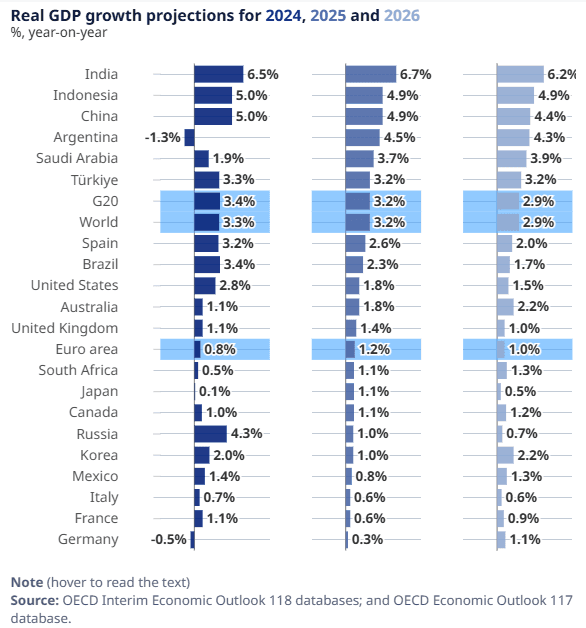
However, there has long been a focus on GDP and it has come under further scrutiny, with an increasing number of critics promoting alternative measurements that focus more on distribution, welfare or assets. Kate Raworth - an author and Economist who populised the term 'Doughnut Economics’, has called for an improvement to the current measurement system which incorporates un-monetised goods, underlying assets and distributive effects. While the revised figures from the OECD do create a positive outlook for the global economy, they can fail to shed light on some of the more important issues or successes we are facing[17].
Editor: Dinel Gamage Liam Sanderson
Writers: Liam Sanderson, Saaina Bajaj
References:
[1] Financial Times - https://www.ft.com/content/2984eec8-f912-4e11-b0f9-ba30ee3adf8b
[2] Financial Times - https://www.ft.com/content/091c8eb2-b166-4f03-bfb0-9aa77e95186b
[3] Economist - https://www.economist.com/europe/2025/10/02/how-europe-crushes-innovation
[4] World Economic Forum - https://reports.weforum.org/docs/WEF_Future_of_Jobs_Report_2025.pdf
[5] Wall Street Journal - https://www.wsj.com/business/deals/ea-private-deal-buyout-video-game-maker-808aefec
[6] Financial Times - https://www.ft.com/content/be980240-13ec-498c-ba79-71eada30d133
[7] Economist - https://www.economist.com/business/2025/10/02/with-electronic-arts-saudi-arabia-scores-a-record-buy-out
[8] Financial Times (2025). Silver, the precious metal ready to outshine gold. https://www.ft.com/content/4d98e095-a3d9-4c40-9597-3948ba6208b3
[9] Economist (2025). Why silver is the new gold. https://www.economist.com/finance-and-economics/2025/03/05/why-silver-is-the-new-gold
[10] Reuters (2025). Silver surges past $35/oz level to hit more than 13-year high. https://www.reuters.com/business/silver-surges-past-35oz-level-hit-more-than-13-year-high-2025-06-05/
[11] Silver Institute (2024). Global Industrial Demand on Track for a New Record High. https://silverinstitute.org/global-industrial-demand-on-track-for-a-new-record-high-in-2024/
[12] McKinsey (2025). How QuantumBlack helps clients use AI by design. https://www.mckinsey.com/capabilities/quantumblack/how-we-help-clients
[13] WSJ (2025). AI Is Coming for the Consultants. Inside McKinsey, ‘This Is Existential.’ https://www.wsj.com/tech/ai/mckinsey-consulting-firms-ai-strategy-89fbf1be
[14] WSJ (2025). How the AI boom is leaving consultants behind. https://www.wsj.com/articles/how-the-ai-boom-is-leaving-consultants-behind-c9088fda
[15] OECD - https://www.oecd.org/en/publications/oecd-economic-outlook-interim-report-september-2025_67b10c01-en.html
[16] Supply Chain Dive - https://www.supplychaindive.com/news/oecd-economy-tariffs-gdp-aluminum-steel-plastic/761037/
[17] Kate Raworth - https://www.kateraworth.com/2012/07/01/want-to-know-how-to-get-beyond-gdp-start-here/
