Edition 11
Dec 4, 2025

Your Business Snapshot:
💼 A major tax and spend shift as Reeves targets high earners and property wealth to fund NHS and public services.
🛍️ Record footfall but weaker spending as US and UK shoppers stay cautious.
📉 European equities hold steady as cooling inflation contrasts with weak banks, softer industrials and uncertainty over ECB policy.
💬 EU proposes easing AI and data rules, sparking privacy concerns.
Economics
Reeves Unveils Revenue Raising 2025 Budget
On the 26th of November, Chancellor Rachel Reeves delivered the long-awaited 2025 budget with a clear aim in raising revenue, and a promise in stabilising public finances and investment in public services. Her budget reflects one of the most significant tax shifts in a decade, aiming to help support the NHS, public schools and other areas within the public sector. At the heart of it all, the tax-raising strategy of gaining up to £26 billion is designed to create fiscal stability while moving the UK from pre-existing austerity, where the UK’s government relied heavily on spending cuts to reduce deficits to now taxing higher income households and assets to maintain spending on the public sector[1].

A core foundation of Reeves’ budget is freezing income tax on UK households for another three years up until 2028 and the National Insurance thresholds. This creates fiscal drag, where due to the effects of inflation and nominal wages increasing, families are pushed into higher tax brackets, meaning they will have to pay a higher percentage of taxes. Whilst it’s a tax-revenue generating strategy employed by Reeves and coined a ‘stealth tax’, it has both short and long term consequences, raising questions if it actually raises revenue for the government. This is down to recent data showing a rise in emigration from the UK in 2024/25, where over 16,500 millionaires are expected to leave, with more business and households moving abroad in fears of these existing tax brackets[2].
This is coupled with fears that Reeves new measure aims to target wealth and investment income, including a reduction in ISA allowances, capping salary pension benefits and adding new surcharges on high-value residential properties. From April 2028, the High Value Council Tax Surcharge applies in England to homes valued at £2+ million, a surcharge on top of the council tax, rising with CPI inflation from 2029-30 onwards. Houses over £5+ million will have to pay an extra £7,500 a year[3]. This re-enforces the Chancellors belief that wealthy individuals with larger assets should contribute more to fix public services and stabilise national finances than the working population, and help reduce wealth inequality. However, this could also hurt investment flows and long-term savings should further tax raises persist in the future. This comes after the National Minimum Wage has been increased from £10 to £10.85 an hour for 18-20 yr olds, with the national living wage going up from £12.21 to £12.71 an hour. This is seen to help protect workers from the cost of living, yet it could significantly put pressure on companies within the hospitality and retail sector. With mounting costs of labour for firms, it can have negative impacts on employment as businesses may choose to offload workers to uphold profits.
Another large part of Reeve’s new budget is public investment. This is a huge pillar of the budget, with increased stress on the importance of modernising and funding NHS facilities and expanding school funding. Reeves highlights this in her budget, where extra investment amounts to £5m extra for secondary school libraries and £18m on improving school facilities. This is followed by using over £4.9bn to be spent on the health sector, primarily through NHS’s labour force like nurses and GP’s. In addition, another £300m of investments in technology to improve patient services and providing up to 250 new local patient health centres[1]. Reeves' approach in the 2025 budget highlights how the UK is moving away from austerity and with investments in the NHS, it reflects her desire to combat the delays within the healthcare sector following Covid 19.
To conclude, Reeves 2025 budget signals a monumental shift in the UK’s fiscal direction. Her approach of taxing the rich and investing capital into the public sectors is controversial and it remains to be seen if this is effective in maintaining long-term financial stability. However, it is certain that the new budget outlines a clear breakaway from the post-2010 austerity model, where the UK government relied heavily on spending cuts to reduce deficits and balance books. Instead, Reeves has opted for a more tax and invest approach, raising revenue from high income earners in order to facilitate extra spending on the NHS, raising the minimum wage, investing in the public sector to help protect households from the rising costs of living.
Business
Black Friday spending slows despite record shopper turnout
Last week saw the occurrence of ‘Black Friday’ in the US and the UK, giving retailers the chance to benefit from an upsurge in footfall and revenue.
Coming into the day, Americans were expected to shop in record numbers, but spend less money overall. This forecast was driven by tariffs and the cost of living situation in the US. To quantify things: over 187mn people were expected to shop over Black Friday and Thanksgiving weekend and were planning to spend $622 on average (down 4% from last year)[1]. This crucial sales period kicks off the winter holiday shopping season, known to make or break a retailer's profits. There are many political and economic reasons to point to the fact that this tactic won’t have the usual success. Current concern over stubborn inflation and higher unemployment have been cited as a number of reasons for restricting spending, this is supported by consumer sentiment being at a three-year low[1]..
In the UK the story is slightly different, as covered in our Economics section, the budget last Wednesday is likely to have had many large effects. Many UK retailers have been left frustrated over the timing of the budget, as it has had many effects on the success of black friday. Forecasting demand was made much harder by the government’s decision to hold the Budget, as retailers couldn’t predict how fiscal changes would feed through to people’s decision to spend. Additionally, any negative outlooks set by Rachel Reeves, such as freezing of the tax bands, could have led to a natural aversion to spending if consumers feel the need to reign in their own budget[2].
One thing that can be guaranteed will be the natural move to online shopping, while many shoppers still appreciate the ability to shop-in person, people are continually moving online. Figures from last year show that online Black Friday purchases increased by 14.6% from the previous year. This trend threatens many firms in both the US and UK that don’t have a strong online presence such as Primark. Use of online shopping has shifts consumer spending patterns, with many firms citing that Black Friday has not been the same since Covid-19[3]. Firms often choose to manipulate their UI to attract people to better deals and direct them to their specific interests, in-store shopping does not act the same way, businesses have less flexibility in how they can match everybody's interests and market deals.

To conclude, Black Friday was likely slightly different this year and time will tell as figures from the weekend start to trickle in.
Markets
European Markets Trade Cautiously Amid Mixed Signals
European equities moved in a tight range this week as investors weighed solid corporate earnings against persistent inflation worries and an uncertain monetary outlook. In the UK the FTSE 100 nudged higher after the latest consumer‑price data showed inflation slipping to 2 percent, the lowest level in two years[1]. The Bank of England said any rate reduction will still be several months away, a comment that kept the market cautious despite the positive price trend. Retailers such as Marks & Spencer posted a modest sales increase, while energy firms benefited from lower wholesale fuel costs, helping the index close with a small gain. Financial stocks lagged as banks continue to feel pressure from tighter credit conditions and a narrowing net‑interest margin.
Germany’s DAX fell slightly after the European Central Bank left its key interest rate unchanged at 3.5 percent and reiterated a gradual path to policy normalisation[2]. The decision reflected the ECB’s desire to see inflation firmly anchored before easing, a stance that tempered optimism among industrial investors. German manufacturers reported a slowdown in new orders, especially in the automotive supply chain, adding to the sector’s drag. Yet the technology segment of the DAX performed well, with several mid‑cap software and cybersecurity companies beating earnings expectations and raising guidance for the next fiscal year. The stronger tech earnings helped offset some of the broader market weakness.
Energy markets continued to influence European equities. Natural‑gas prices fell around 5 percent after the International Energy Agency projected a milder winter, easing cost pressures on industrial producers but also narrowing the profit margin for renewable‑energy firms that have benefited from higher spreads. The European Commission’s €200 billion green‑investment plan, aimed at funding sustainable projects over the next five years, is expected to provide a boost to the renewable sector, though investors remain watchful of how quickly funds will be allocated.
Banking stocks across the eurozone faced headwinds as credit conditions tightened and loan‑growth forecasts were revised downward. Major banks announced cost‑saving initiatives, including branch consolidations and digital‑service upgrades, with the hope of improving profitability later in the year. These measures will be scrutinised by analysts looking for evidence that banks can maintain earnings in a low‑rate environment.
Overall, the European market picture is one of cautious optimism. Inflation is easing in the UK and France, giving some relief to consumers and policymakers, yet the ECB’s steady stance suggests that major monetary easing is still some way off. Strong earnings in technology and luxury goods provide positive momentum, while banking and industrial sectors contend with tighter credit and slower order flows. Energy price volatility and geopolitical tensions, particularly in Eastern Europe, continue to add uncertainty. Investors are likely to keep a diversified approach, rotating between defensive sectors and selective growth opportunities, while closely monitoring the ECB’s next policy decision and the rollout of the EU’s green‑investment agenda.
Tech
EU pulls back on AI rules amid digital overhaul
On November 19th, 2025, the European Commission was accused of a "massive rollback" of the EU's digital rules after announcing a proposal to delay key parts of the Artificial Intelligence Act.
The EU agenda has shifted since the last Italian Prime Minister, Mario Draghi, announced that Europe had fallen behind the US and China in innovation and was weak in emerging technologies. Trump's administration also put pressure on the EU to rein in digital laws[1].
If agreed, changes would make it easier for tech firms to use personal data for training AI models without asking as much permission. For example, the new rules aim to end "cookie banner fatigue"[2]. The plan was part of the "Digital Omnibus," which is due to the European Commission, "a set of technical amendments to a large corpus of digital legislation, selected to bring immediate relief to businesses, public administrations, and citizens alike, and to stimulate competitiveness." It would aim to streamline tech rules, including the General Data Protection Regulation (GDPR), the AI Act, the ePrivacy directive (which governs cookie law), and the Data Act.

Taken together, these changes will give both authorities and powerful companies more room to collect and process personal information with reduced transparency. While European business groups welcomed the proposals, more than 120 civil society organisations argued that "Digital Omnibus" does not bring simplification but deregulation. They said, "What is being presented as a 'technical streamlining' of EU digital laws is, in reality, an attempt to dismantle Europe's strongest protections against digital threats covertly." The head of Policy from EDRi said "We have to ask: who really benefits from this broad deregulatory agenda? Because if you want to be able to breathe clean air, protect workers from abuse, and go online without being tracked by hundreds of bad actors, then you certainly won’t."[4]
In the end, the Digital Omnibus shows an evident tension between encouraging new tech and protecting people’s digital rights. What happens next will determine whether the EU can update its rules without sacrificing too much privacy and transparency.
Bonus Section
Chart of the week
This week's chart covers the company segmentation of the US stock market. As shown below 39% of stocks in the S&P 500 were internet-related, this occurred right at the peak of the dotcom bubble, which eventually saw these firms plummet[1]. Currently the scene in the US market shows both similarities and differences. As clearly displayed the total is 52%, which is significantly higher than in 2000, this could show a clear sign of a stock market bubble, as discussed in previous newsletters, or it could put it in scale the dramatic effects that AI could have on the global economy, even shadowing the effects of the world-wide-web[1].
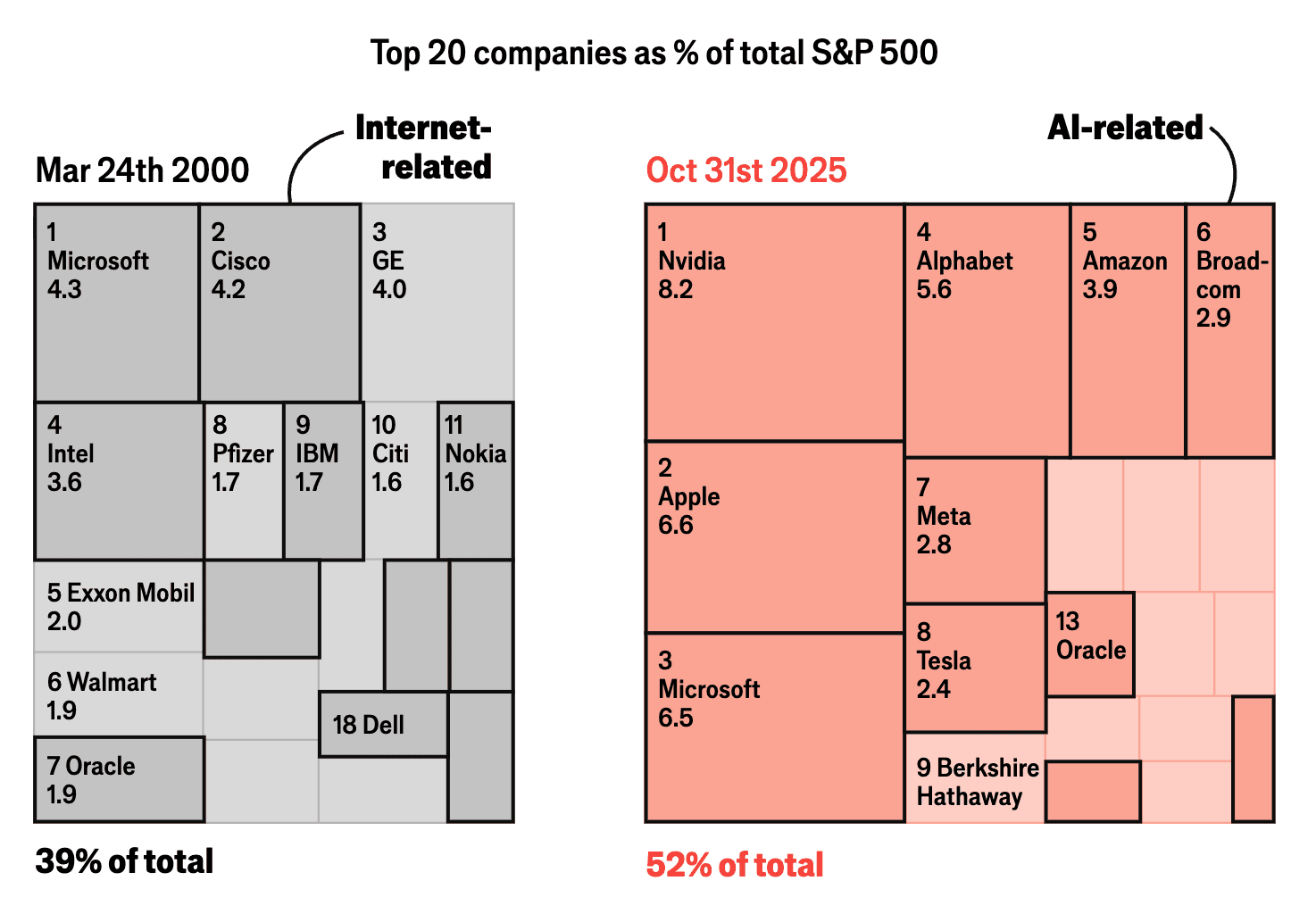
The concerns around tech-firm seem to reflect the same causes of the dotcom bubble, profitability. Many of the over-valued firms that rode the wave of IPO’s in the late 1990s and looked extremely promising failed due to an inability to churn out revenue and profit[2]. Today we see many of the large firms unable to generate profit, such as Open AI. However, in contrast to this, Open AI is currently a private listed firm, many of the publicly traded firms above are profitable and seem to be on course to remain so. Additionally today we are seeing unforeseen levels of tech investment, if this continues then there is definitely an argument that the benefits of this new technology will shine through into company profits and real-world innovation and we may be able to ride out the ‘AI bubble’.
Editors: Liam Sanderson, Dinel Gamage
Writers: Liam Sanderson, Filip Wang, Cleo Vuillot, Harshil Nichani
References:
Economics: [1] The Guardian - https://www.theguardian.com/uk-news/2025/nov/26/budget-2025-key-points-rachel-reeves
[2] Henley Global - https://www.henleyglobal.com/publications/henley-private-wealth-migration-report-2025/what-driving-uks-millionaire-exodus?
[3] Gov.uk - https://www.gov.uk/government/publications/high-value-council-tax-surcharge/high-value-council-tax-surcharge?
Business:
[1] Financial Times - https://www.ft.com/content/4ef8cd12-8a1b-4a16-823d-f3426395d794
[2] Financial Times - https://www.ft.com/content/0eaec315-61bd-4c4f-aa9f-acea2225adad
[3] Financial Times - https://www.ft.com/content/460748f7-7d9b-41a4-93a6-9372e9bf2f6e
Markets:
(1) FT – “UK inflation drops to 2 percent, markets react” https://www.ft.com/content/uk‑inflation‑2025
(2) Bloomberg – “ECB holds rates steady, signals gradual easing” https://www.bloomberg.com/news/ecb‑rates‑2025
(3) The Economist – “Europe’s green‑investment plan and its
Tech:
[1] The Guardian - https://www.theguardian.com/world/2025/nov/19/european-commission-accused-of-massive-rollback-of-digital-protections.
[2] Business Business and Human Rights Centre - https://www.business-humanrights.org/en/latest-news/eu-commission-accused-of-massive-rollback-of-digital-protections/
[3] Shaping Europe’s digital future - https://digital-strategy.ec.europa.eu/en/library/digital-omnibus-regulation-proposal.
[4] European Digital Rights (EDRi) - https://edri.org/our-work/commissions-digital-omnibus-is-a-major-rollback-of-eu-digital-protections/
Bonus Section:
[1] Economist - https://www.economist.com/interactive/graphic-detail/2025/11/05/how-much-wealth-would-be-destroyed-by-an-ai-stockmarket-crash
[2] Goldman Sachs - https://www.goldmansachs.com/our-firm/history/moments/2000-dot-com-bubble
